Multi-seed analysis
GRADIEND training can differ across random seeds. Most workflows train until one
converging seed is found (min_convergent_seeds=1) and use that checkpoint for
everything else.
Multi-seed analysis trains several converging seeds, keeps each checkpoint on disk, and lets you report mean metrics with dispersion (typically std) instead of a single lucky run.
This guide covers training, the trainer.multi_seed() view, aggregated eval,
and encoder plots with mean ± std. Pairwise checkpoint similarity (top-k overlap,
cosine heatmaps, gradiend_only=True) is cross-model comparison — same seeds, different question.
Runnable example (covers every section below):
python -m gradiend.examples.train_multi_seed_stability
python -m gradiend.examples.train_multi_seed_stability --plot-only          # cached checkpoints
python -m gradiend.examples.train_multi_seed_stability --write-docs-images  # refresh docs/img/
Quick verification without full training: pytest tests/test_multi_seed_view.py tests/test_multi_seed_analysis_integration.py -q
Quick start
args = TrainingArguments(
    experiment_dir="runs/my_feature",
    max_seeds=5,
    min_convergent_seeds=3,            # must be <= max_seeds; training ends after this many converging seeds
    analyze_seed_stability=True,       # saves all convergent seeds; required for analysis
    fail_on_non_convergence=True,      # scripts should not silently continue
)

trainer = TextPredictionTrainer(..., args=args)
trainer.train()

# Single-seed API — always the selected *best* convergent checkpoint
single = trainer.evaluate_encoder(split="test")
print(single["correlation"])  # 0.8123

# Multi-seed API — aggregate over convergent checkpoints
view = trainer.multi_seed(selection="all_convergent", dispersion="std")
multi = view.evaluate_encoder(split="test")
print(multi["correlation"])                          # 0.7981  (mean across seeds)
print(multi["seeds"]["stats"]["correlation"])        # {"mean": 0.7981, "std": 0.014, "n": 2, ...}

view.plot_encoder_by_target(
    split="test",
    plot_style="errorbar",
    error_stat="std",
    show_seed_points=True,
)
:material-file-code-outline: train_multi_seed_stability.py
Training settings
args = TrainingArguments(
    experiment_dir="runs/my_feature",
    max_seeds=5,
    min_convergent_seeds=3,            # must be <= max_seeds; training ends after this many converging seeds
    saved_seed_runs="best_only",
    analyze_seed_stability=True,       # required for multi_seed(); sets saved_seed_runs to "all_convergent"
    fail_on_non_convergence=True,      # scripts should not silently continue
)
| Argument | Meaning |
|---|---|
max_seeds |
Maximum seeds to try |
min_convergent_seeds |
Stop once this many converge; None = run all max_seeds |
analyze_seed_stability |
Save every convergent checkpoint for later analysis. Sets saved_seed_runs to "all_convergent" (forbidden with "best_only") |
saved_seed_runs |
Which runs are kept: best_only, all_convergent, or all_tried |
fail_on_non_convergence |
Raise if fewer than min_convergent_seeds converge |
See
<experiment_dir>/seeds/seed_report.jsonfor per-seed training details.
Checkpoints live under <experiment_dir>/seeds/seed_<N>/. The best seed is still
copied to <experiment_dir>/model/ for the default single-seed API.
Single-seed vs multi-seed API
| Call | Uses | Returns |
|---|---|---|
trainer.evaluate_encoder(...) |
Best convergent checkpoint only | One correlation, one plot |
view.evaluate_encoder(...) |
Every selected seed | Mean metric + seeds.stats dispersion |
trainer.get_model() |
Best checkpoint (full base + GRADIEND) | ModelWithGradiend |
view.get_model() |
Every selected seed | SeedModelGroup when N > 1 |
trainer.multi_seed() returns a MultiSeedTrainerView. It exposes the same
eval/plot method names as Trainer, but runs them per seed and aggregates.
To reuse an existing analysis script, rebind after training:
trainer.train()
view = trainer.multi_seed(dispersion="std")  # analysis mode: rebind for scripts

enc = view.evaluate_encoder(split="test", return_df=True)  # mean encoder_df + seeds.stats
View options
view = trainer.multi_seed(
    selection="all_convergent",  # best | all_convergent | all_tried
    aggregate="mean",            # mean | median | min | max
    dispersion="std",            # none | std | range | minmax
    return_per_seed=False,       # True -> full per-seed payloads under seeds.per_seed
)
| Option | When to use |
|---|---|
selection="all_convergent" |
Stability analysis (default when analyze_seed_stability=True) |
selection="best" |
Same as single-seed, but through the view API |
aggregate="mean" |
Tables and summary plots |
dispersion="std" |
Report spread in seeds.stats — use for paper claims |
return_per_seed=True |
Debug or custom downstream aggregation |
When dispersion is omitted, it defaults to "std" if analyze_seed_stability=True,
else "none".
Evaluation results
enc = view.evaluate_encoder(split="test", return_df=True)

enc["correlation"]                    # aggregated scalar (mean by default)
enc["seeds"]["n"]                     # how many seeds were aggregated
enc["seeds"]["values"]                # seed integers
enc["seeds"]["stats"]["correlation"]  # {"mean", "std", "min", "max", "n", ...}
enc["encoder_df"]                     # mean encoder_df across seeds (when return_df=True)
The same aggregation applies to evaluate(), evaluate_decoder(), and other
dict-returning eval methods on the view.
Plots
All plots below are produced by
train_multi_seed_stability.py.
Regenerate doc figures with --write-docs-images.
Encoder by target (mean ± std)
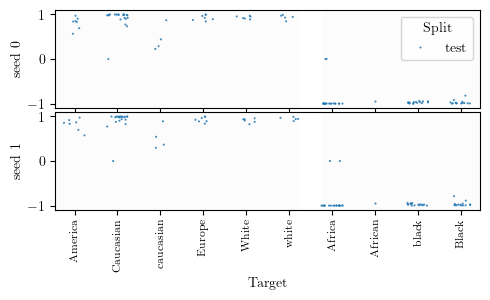
Best plot for vocabulary-held-out stability. view.plot_encoder_by_target() evaluates
each seed, then renders a multi-seed figure.
Default — one row per seed (compare seeds visually):
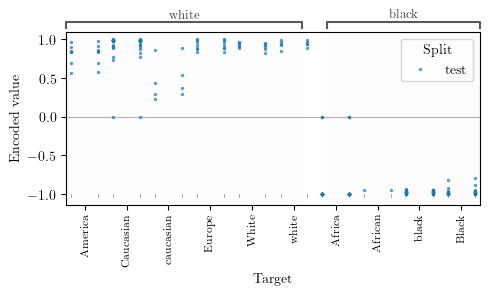
Combined strip — all seeds on one row (overlay points, shared x-axis):
view.plot_encoder_by_target(
    split="test",
    combine_seed_rows=True,
    output="encoder_by_target_combined.pdf",
)
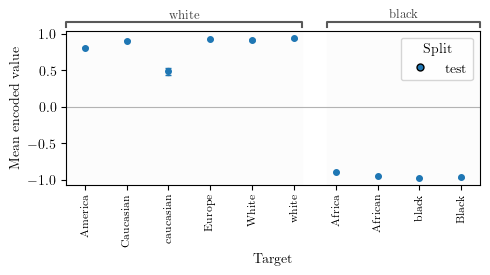
Error bar summary — mean ± std per target (publication-friendly):
view.plot_encoder_by_target(
    split="test",
    plot_style="errorbar",
    error_stat="std",        # or "sem"
    show_seed_points=True,   # faint individual seed points behind bars
    output="encoder_by_target_errorbar.pdf",
)
Interactive (Plotly HTML, requires gradiend[plot]):
Other encoder plots
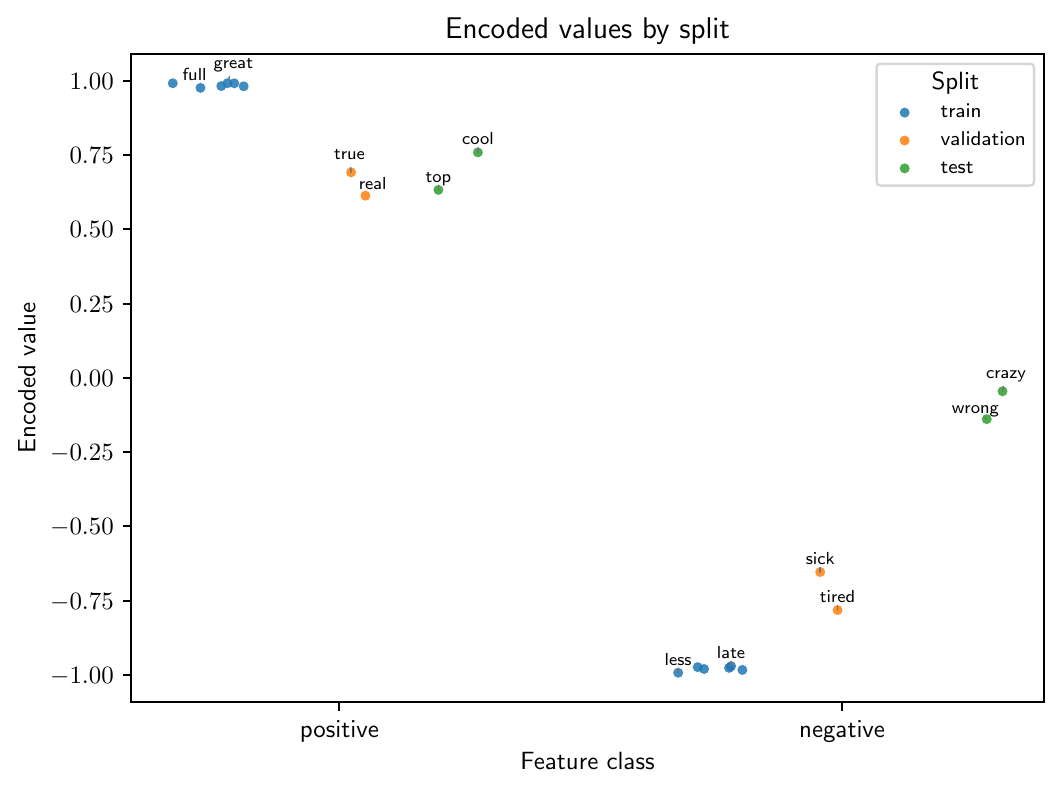
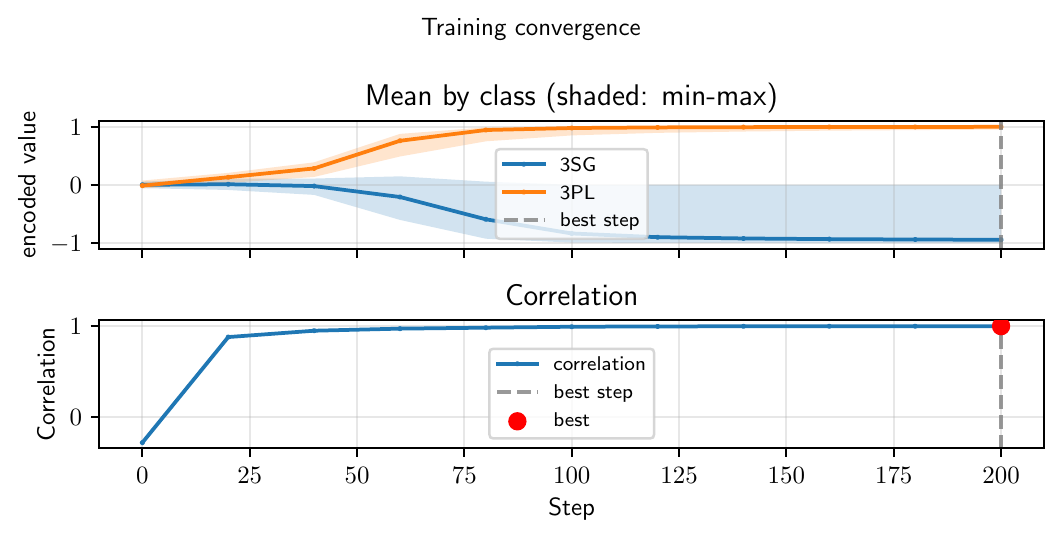
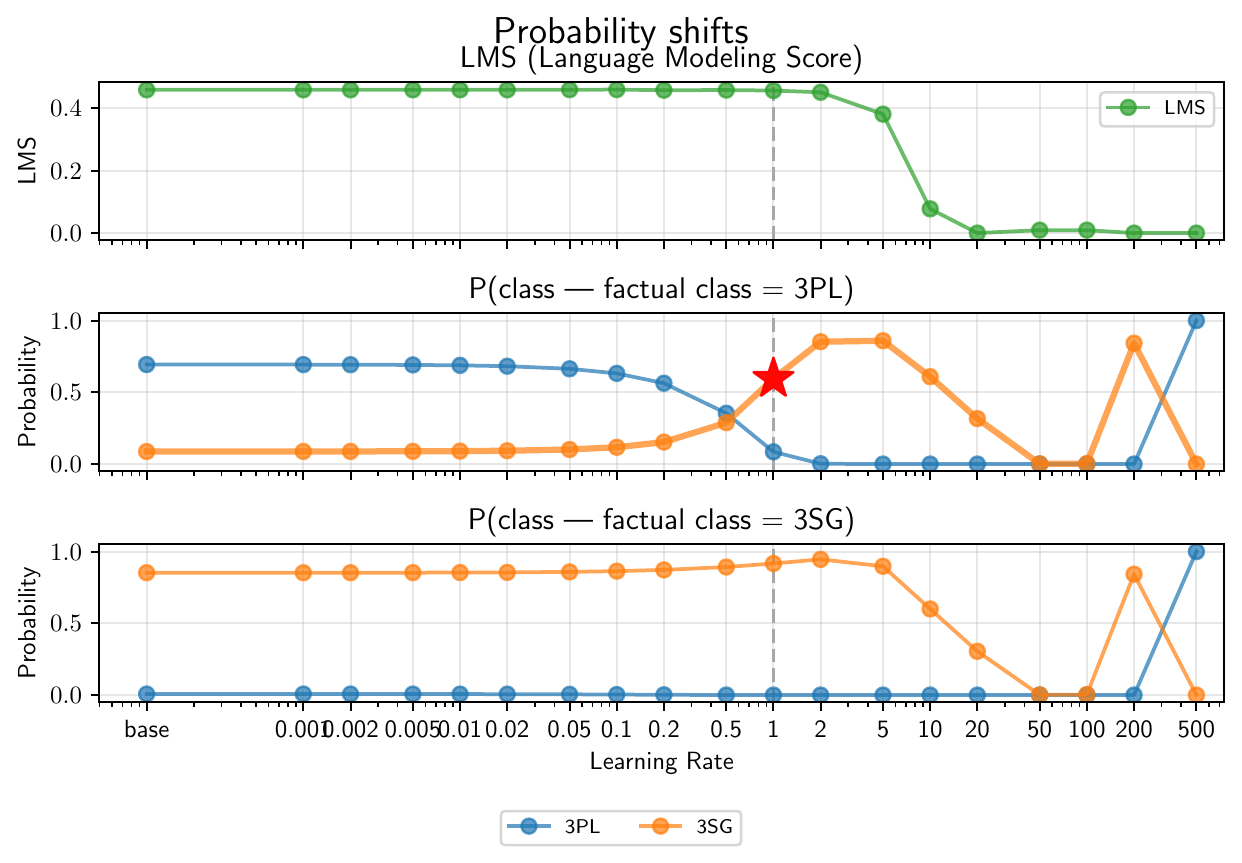
These methods run once per convergent seed and return result["paths"] (one file
per seed) plus result["path"] (first file, convenience):
| Method | Figure (one seed shown) |
|---|---|
view.plot_encoder_distributions(...) |
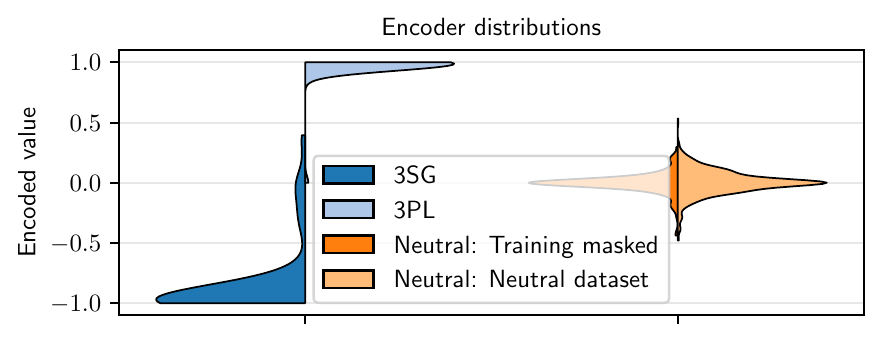 |
view.plot_encoder_scatter(...) |
 |
view.plot_training_convergence(...) |
 |
view.plot_probability_shifts(...) |
 |
Implementation: run_other_encoder_plots() in train_multi_seed_stability.py.
There is no built-in mean±std violin overlay for distributions — use
plot_encoder_by_target(..., plot_style="errorbar") for aggregated target-level
summaries, or compare the per-seed distribution files side by side.
Trainer suites
If a child trainer uses analyze_seed_stability=True, TrainerSuite.train() replaces
that child with a multi-seed view automatically. Suite heatmaps then include all
convergent seeds for that child without extra wiring.
Only enable multi-seed on suites after each child converges reliably on its own — suites multiply failure modes.
See Trainer suites.
See also
| Topic | Guide |
|---|---|
| Aggregated metrics + dispersion | This page (trainer.multi_seed(), seeds.stats) |
| Pairwise seed checkpoint similarity (top-k, cosine heatmaps) | Cross-model comparison — Comparing seeds |
gradiend_only=True, checkpoint paths |
Saving and loading |
Example script
train_multi_seed_stability.py
covers multi-seed training, aggregated eval, and encoder plots from this guide.
Seed checkpoint similarity heatmaps are documented under
Comparing seeds (same script, run_seed_comparison_heatmaps()).
| Script | Extra focus |
|---|---|
train_sentiment.py (RUN_MODE="multi_seed_heldout") |
Vocabulary-held-out target rotation across seeds |
train_gender_de_detailed.py |
Minimal multi-seed eval on gender DE feature |